

Halloween brings costumes, candy, glowing decorations, and plenty of opportunities to gather with friends and family. It can also leave behind a confusing mixture of pumpkins, wrappers, packaging, and decorations.
The good news is that celebrating more sustainably does not require removing the fun. It simply means knowing what belongs in each waste stream and making a few thoughtful choices before the festivities begin.
Pumpkins and Food Scraps: Compost When Possible
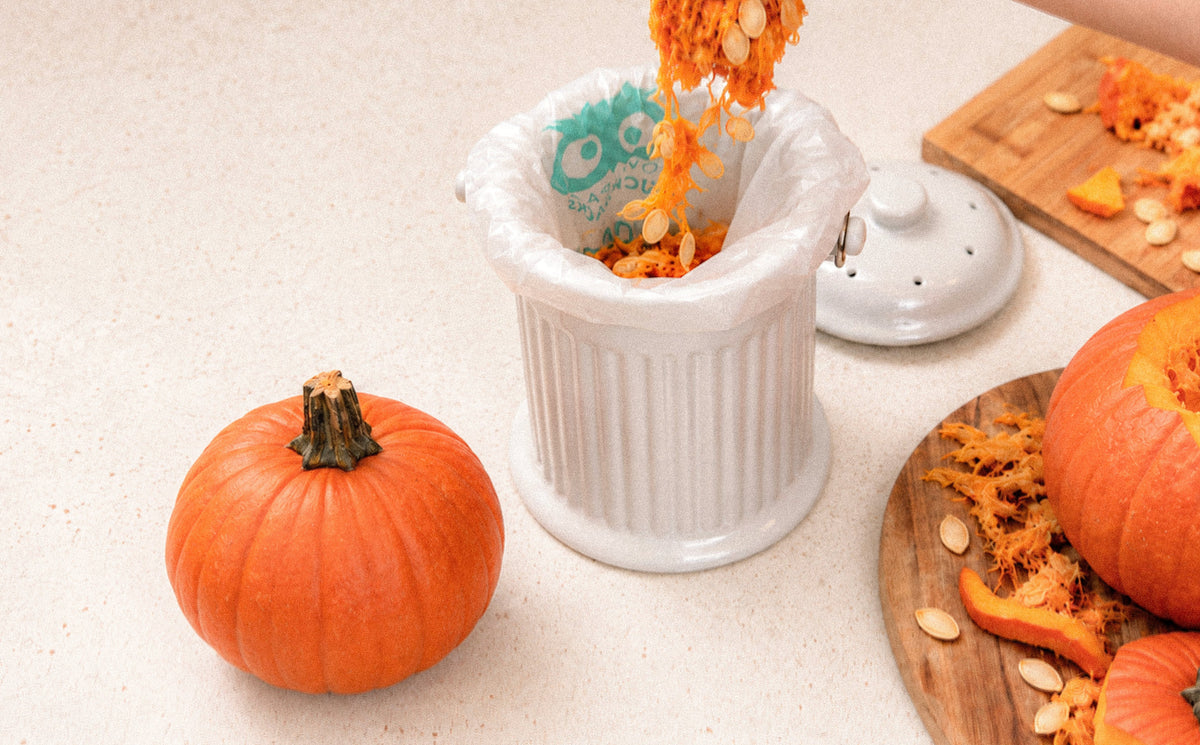
Pumpkins are organic material, making them excellent candidates for composting—as long as everything that is not part of the pumpkin is removed first.
Before composting a jack-o’-lantern:
-
Remove candles, wax, stickers, lights, and decorations.
-
Avoid composting pumpkins covered in paint, glitter, or synthetic materials.
-
Cut the pumpkin into smaller pieces so it breaks down more efficiently.
-
Check whether your local organics program accepts pumpkins and food scraps.
If the pumpkin is still fresh and has not been decorated, consider using it first. Pumpkin flesh can be added to soups, baked goods, sauces, or purées, while cleaned seeds can be roasted for a seasonal snack.
Other Halloween food scraps—such as fruit peels, vegetable trimmings, coffee grounds, and uncoated paper napkins—may also be compostable, depending on your local program. A small countertop compost setup can make collecting scraps easier during parties and pumpkin-carving activities.
The best order is simple: eat what you can, save what you can, and compost what remains.
Costumes: Rewear, Repair, Swap, or Donate
Many Halloween costumes are worn once and then forgotten. Before throwing one away, look at each component separately.
Costumes in good condition can be:
-
Saved for another year
-
Exchanged with friends or neighbors
-
Donated to a school, theater group, community center, or thrift store
-
Restyled into a different character
-
Used for children’s dress-up activities
Minor damage does not always mean a costume has reached the end of its life. Loose buttons, small tears, and detached trims can often be repaired in a few minutes.
For clothing that is no longer wearable, check whether textile-recycling programs are available in your area. Accessories made from mixed plastics, foam, glitter, or electronic components generally do not belong in curbside recycling and may need to be placed in the trash.
Decorations: Separate Before You Sort
Halloween decorations are often made from several materials, which can make disposal complicated. Instead of placing an entire decoration in one bin, separate its components whenever possible.
Here is a helpful starting point:
-
Paper and cardboard: Recycle when clean, dry, and free from glitter, wax, or plastic coatings.
-
Natural decorations: Untreated leaves, straw, branches, gourds, and flowers may be compostable.
-
Fabric decorations: Wash and store them for next year, donate them, or look for textile recycling.
-
Plastic decorations: Reuse whenever possible. Most decorative plastic items are not accepted in curbside recycling.
-
String lights and electronic decorations: Do not place them in regular recycling. Look for an electronics or seasonal-light collection program.
-
Batteries: Remove them and take them to an appropriate battery-recycling location.
-
Artificial spiderwebs: Carefully collect and reuse them. If they are damaged, place them in the trash rather than the recycling bin.
The most sustainable decoration is often the one you already own. Before buying something new, try rearranging existing objects, using natural materials, or choosing pieces sturdy enough to last for several seasons.
Candy Wrappers and Packaging: Avoid “Wishcycling”
Candy wrappers are one of Halloween’s trickiest waste items. Most are made from multiple layers of plastic, foil, or other flexible materials fused together. Because those layers are difficult to separate, most curbside recycling programs do not accept them.
Unless your community or a verified specialty program specifically accepts candy wrappers, they should generally go in the trash.
Placing non-recyclable wrappers in the recycling bin—sometimes called “wishcycling”—does not make them recyclable. Instead, it can contaminate other materials and create additional work for recycling facilities.
Other packaging should be evaluated individually:
-
Clean cardboard candy boxes may be recyclable.
-
Clean paper bags may be recyclable or reusable.
-
Plastic bags and flexible film should only go to designated collection points that accept them.
-
Food-contaminated paper or cardboard usually belongs in the trash or an approved compost program.
-
Reusable candy containers, baskets, and fabric bags can be stored for next year.
Because recycling rules vary by location, always check with your local provider before placing an unfamiliar material in the bin.
Create a Simple Sorting Station
Make cleanup easier by preparing three clearly labeled containers before guests arrive:
-
Compost: Pumpkins and accepted food scraps
-
Recycle: Clean materials accepted by your local program
-
Trash: Candy wrappers, contaminated packaging, and mixed-material decorations
Keep a fourth reusable container nearby for decorations, costumes, and accessories that should be stored rather than discarded.
This simple setup helps guests make better decisions and prevents compostable or recyclable materials from disappearing into the trash during cleanup.
Safer Cordless Lighting for Entrances and Pathways
Halloween lighting should create atmosphere while helping guests see steps, pathways, decorations, and changes in ground level.
Cordless rechargeable lamps can provide flexible illumination without running electrical cables across busy walking areas. They can be placed near:
-
The front door or candy station
-
Porch seating
-
Pathway turns
-
Steps and changes in elevation
-
Indoor entry tables
-
Covered patios or balconies
For safer placement:
-
Keep lamps off stairs and out of the center of walkways.
-
Place each lamp on a flat, stable surface where it cannot be easily knocked over.
-
Aim light toward the walking surface rather than directly into guests’ eyes.
-
Charge lamps fully before trick-or-treating begins.
-
Use only products appropriate for the intended location.
-
Keep indoor-only lamps away from rain, sprinklers, and standing water.
-
Check the product’s IP rating before using it in a damp or covered-outdoor area.
-
Inspect the lamp, battery, and charging cable for damage before use.
Flameless lighting is particularly helpful around costumes, children, pets, paper decorations, and dried natural materials. If you use candles elsewhere, keep them well away from anything that could catch fire and never leave them unattended.
An Owlpack cordless lamp can help illuminate an entryway, porch table, candy station, or indoor gathering while reducing the need for cords in high-traffic areas. The goal is not to make the space excessively bright, but to create a welcoming glow while keeping important walking areas visible.
A Quick Low-Waste Halloween Checklist
Before Halloween
-
Use decorations you already own.
-
Choose costumes that can be worn, swapped, or donated again.
-
Prepare labeled compost, recycling, and trash containers.
-
Set out reusable candy baskets or bags.
-
Charge cordless lamps and inspect their condition.
-
Check your local composting and recycling guidelines.
After Halloween
-
Save reusable costumes and decorations.
-
Remove non-organic materials from pumpkins.
-
Compost accepted pumpkins and food scraps.
-
Separate clean cardboard from plastic packaging.
-
Take batteries and electronic decorations to appropriate collection programs.
-
Keep candy wrappers out of curbside recycling unless your local program specifically accepts them.
Celebrate Thoughtfully, Not Perfectly
A lower-waste Halloween is not about getting every decision perfect. It is about becoming more intentional with what you buy, how long you use it, and where it goes when the celebration ends.
By reusing decorations, giving costumes another life, composting pumpkins, sorting packaging correctly, and choosing safer rechargeable lighting, you can create a Halloween that feels festive, welcoming, and a little lighter on the planet.
Share:
Going “Plastic Negative”: What It Means & Our Roadmap